We discovered the Saint Gotthard pass like many do; informed by our GPS that there was a two hour delay in the tunnel, we decided to let the GPS guide us up and over the mountains. We were pleasantly surprised at the excellent road conditions and stunning alpine views. We also learned that our trip wouldn't take much longer than our planned route--unless we stopped too long at the view spots.
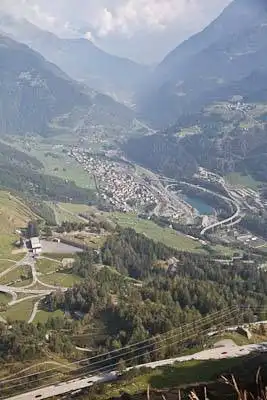
To note: delays at the tunnel, especially during tourist season, are quite frequent. The remedy for this, if you can stomach the hairpin turns, is to take the road over the pass--highly recommended in summer. There's actually lots to see and even some interesting places to stay, including the San Gottardo Hospice, or Ospizio San Gottardo, originally built in 1237 and recently renovated into a hotel.
The picture to the right shows the view descending to the town of Airolo.
Gotthard Pass Facts
Location: Gotthard pass (Passo San Gottardo in Italian) is situated 66 kilometers south east of the approximate center of Switzerland and 93 kilometers south east of Bern, a direct link between Zurich and Lugano. Once thought to be home to the highest peaks in the alps, the pass wasn't attractive to the Romans who lived in its shadow, mostly because of the turbulent Reuss river and the steep Schöllenen Gorge, impassible conditions that were only solved in 13th century with the construction of a bridge in typical medieval style and name: Devil's Bridge. Elevation at the pass is 2106 meters.
Transport Innovations: The first road over the pass was opened in 1830. In 1882 the trains made it through via the Wassen and the Gotthard Rail Tunnels. The Gotthard Rail Tunnel construction took 177 lives. The motorway tunnel was only open in 1980; it is the third longest road tunnel in the world. It is the boring and dark way to make it through the mountain.
Construction of the Gottard Railway Tunnel: The 57 km long The Gotthard Base Tunnel is a railway tunnel through the Alps in Switzerland. It opened in June 2016 and full service began the following December.
Driving the Pass
Where to Stop and Have a Look: Heading north out of Airolo you'll find Pian Secco Belvedere. Here you can get out, stretch, get food, have a picnic, take pictures, and, if you're so induced from the hairpin turns, vomit.
At the Top: What to See and Do: As the road flattens out at the top of the pass, signs will direct you to the National Gotthard Museum, which will give you a history of the pass and efforts to make it more easily passable over the years. You can even stay in the Ospizio San Gottardo here. The National St. Gotthard Museum is open from June to September.
You'll notice many lakes in the tree-free granite around the Gotthard area. The Five Lakes hike is a circular hike that starts and ends at the Gotthard hospice. Here are some more hikes in the Gotthard region.
You can also relive a little of the history of the pass by taking a trip in a horse-drawn mail coach from Andermatt rail station aboard the Gotthard post coach.
For Cyclists If you've got a bike, preferably a mountain bike, and lust after rides on historic roads, the pristine cobble-stoned Tremola should be just the ticket. For description, map and route information, see: Passo San Gottardo (St. Gotthard Pass) - both sides.
When to Go: Of course, with its high elevation, the pass won't be open in winter, but it's a great place to escape the heat in summer and shoulder seasons, May through October. Below is the current weather and forecast.
Itineraries: One of the Scenic Train Routes in Switzerland& is The William Tell Express route that takes you from Lake Lucerne to Bellinzona and on to either Lugano or Lucarno in the Ticino region.
